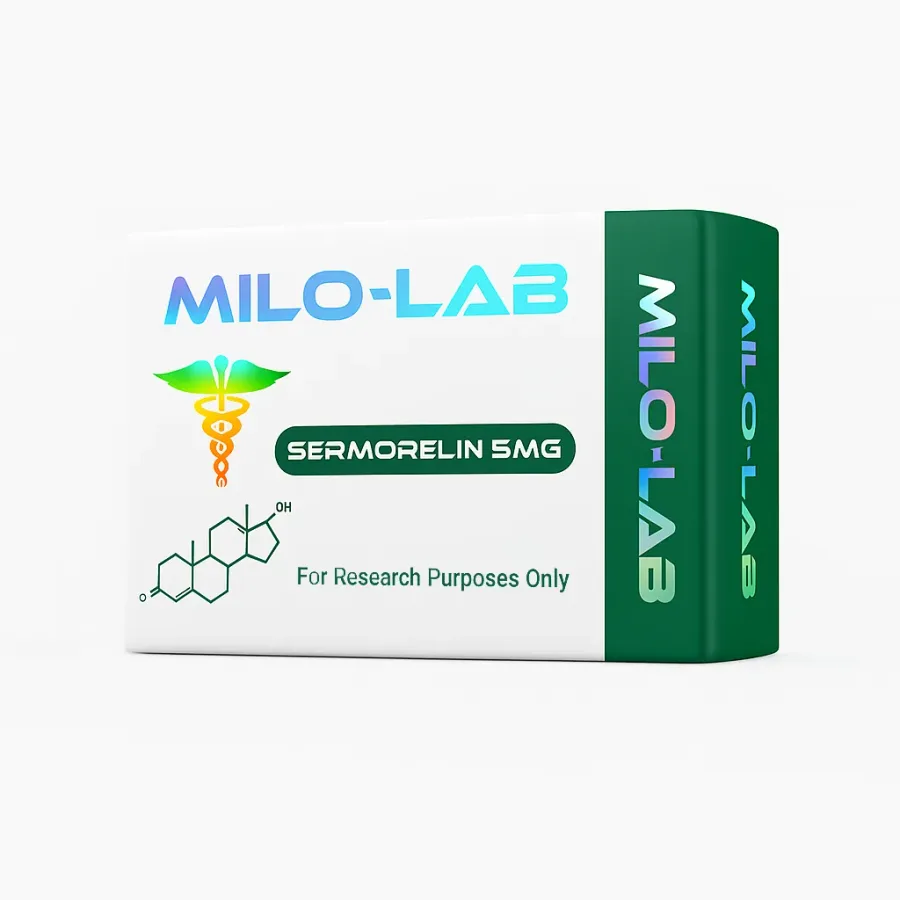
Sermorelin
Sermorelin (GRF 1-29) is a synthetic GHRH-analogue peptide that stimulates the pituitary to release growth hormone in natural, pulsatile rhythm.
Total Price
฿800
For research & laboratory use only. Not for human consumption.
Half-Life
~7-12 minutes
Administration Route
Subcutaneous injection
Natural GHRH Sequence
First 29 amino acids of endogenous growth hormone-releasing hormone
Hypothalamic Feedback
Preserves natural GH axis; avoids pituitary suppression
Anti-Aging HGH
Restores youthful GH output in age-related decline
Mechanism of Action
Scientific Research
Endocr Rev (1997)
J Clin Endocrinol Metab (1996)
Endocr Rev (1997)
Why Researchers Choose Sermorelin
Sermorelin is the GHRH(1-29) peptide with the deepest pharmacological literature, which makes it the reference secretagogue whenever a study needs a physiological growth-hormone stimulus rather than exogenous HGH. Common research directions include:
- GHRH-receptor signalling and pituitary somatotroph responsiveness
- Pulsatile versus continuous GH-release dynamics
- Age-related GH decline (somatopause) and the aging GH axis
- Body-composition models (lean mass, fat distribution)
- Sleep-related GH secretion, since the largest GH pulse follows slow-wave sleep onset
- Benchmarking against modified analogues such as CJC-1295 and tesamorelin
Why the GHRH(1-29) Fragment is Enough
Native GHRH is 44 amino acids long, but its activity is concentrated in the N-terminal segment:
- Residues 1-29: receptor binding and full biological agonist activity
- Residues 30-44: dispensable for receptor activation, with a possible role in molecular stability
Because the 1-29 fragment retains full potency at the GHRH receptor, sermorelin behaves as a functional equivalent of full-length GHRH while being far simpler to synthesise as a research peptide.
Pulsatile Release and Somatostatin Feedback
The short ~7-12 minute half-life is a feature, not a limitation: it lets sermorelin operate inside the natural hypothalamic-pituitary rhythm.
- The hypothalamus normally releases GHRH in pulses across the day
- Between pulses, somatostatin (SRIF) tone suppresses GH release
- Sermorelin, like native GHRH, acts mainly during the low-somatostatin windows
- The result is a preserved pulsatile GH pattern, which matters for receptor sensitivity and anabolic signalling
Long-acting GHRH analogues with multi-day half-lives instead produce more continuous GH elevation that overrides this inhibitory rhythm.
Clinical Background
Sermorelin was marketed as Geref (Serono) and used for GH-provocation testing and for idiopathic GH deficiency in children. Subsequent investigational work in adults has explored its effects on somatopause, body composition, and sleep-dependent GH output, building the long track record that distinguishes sermorelin from newer GHRH analogues.
Reconstitution and Storage
Reconstitution: use bacteriostatic water; swirl gently until dissolved, do not shake. After reconstitution: store refrigerated and use within 2 to 3 weeks; protect from light.
For research purposes only. Not for human consumption.
Dosing at a Glance
Route
Subcutaneous injection
Frequency
Once daily (evening)
Typical research dose
100–300 mcg
Opens the calculator with this peptide preselected. Research reference only.
Product FAQs
Stacks Well With
Related Products
CJC-1295 (no DAC)
CJC-1295 without DAC (Mod GRF 1-29) is a short-acting GHRH analogue that triggers pulsatile growth hormone release for muscle, recovery and fat-loss research.
Ipamorelin
Ipamorelin is a selective pentapeptide growth hormone secretagogue (GHRP) that triggers clean, pulsatile GH release without spiking cortisol or prolactin.
Tesamorelin
Tesamorelin (Egrifta) is an FDA-approved GHRH(1-44) analogue that stimulates natural growth hormone release to drive visceral fat loss and IGF-1 production.