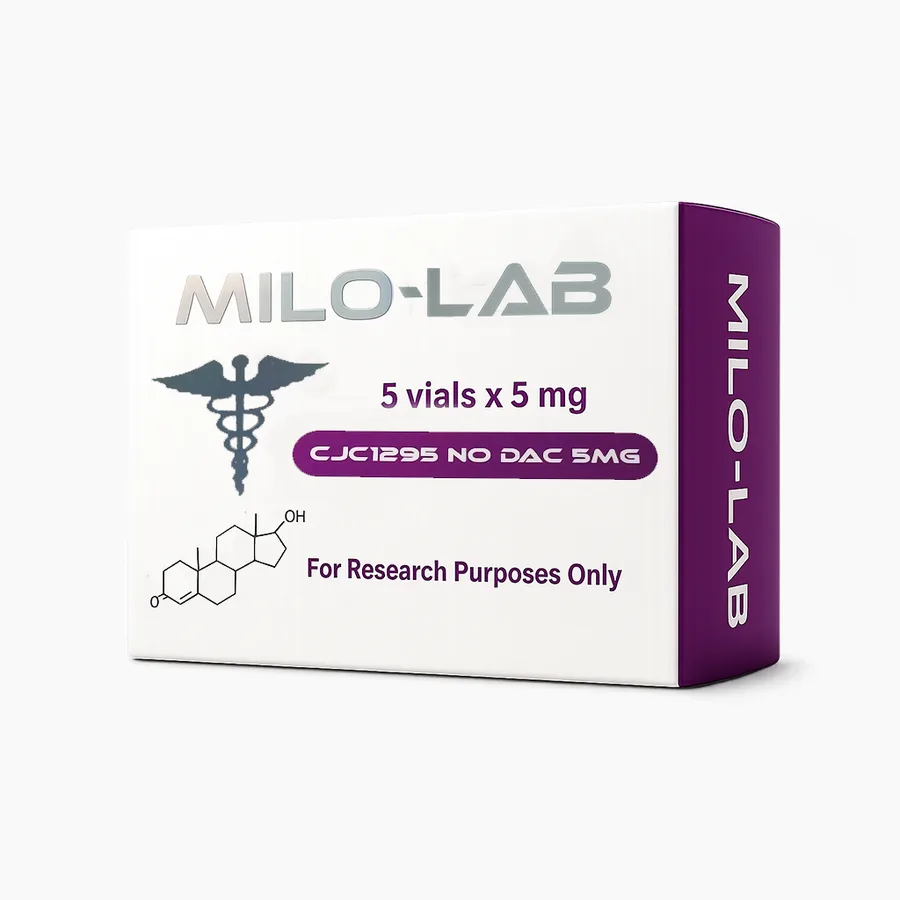
CJC-1295 (no DAC)
CJC-1295 without DAC (Mod GRF 1-29) is a short-acting GHRH analogue that triggers pulsatile growth hormone release for muscle, recovery and fat-loss research.
Total Price
฿1900
For research & laboratory use only. Not for human consumption.
Half-Life
~30 minutes
Administration Route
Subcutaneous injection
Physiological GH Pulse
Short-acting GHRH analogue mimics natural pulsatile release
No Receptor Desensitisation
Preserves GHRH receptor sensitivity vs DAC version
Flexible Dosing
Multiple daily doses match natural GH rhythms
Mechanism of Action
Scientific Research
Biochem Biophys Res Commun (1988)
Endocrinology (1999)
Why Researchers Choose CJC-1295 No DAC
CJC-1295 without DAC, the Modified GRF 1-29 peptide, is one of the most studied short-acting GHRH analogues in performance and recovery research. Its appeal is the way it raises growth-hormone output while keeping the body’s natural pulsatile rhythm intact, which makes it a frequent reference compound wherever physiological GH signalling matters:
- Pulsatile growth-hormone release and somatotroph signalling studies
- Muscle protein synthesis, recovery and lean-mass research
- Lipolysis and body-composition (fat-loss) investigations
- GHRH receptor sensitivity and tachyphylaxis comparisons against DAC-bound analogues
- Synergy modelling with GHRP secretagogues such as ipamorelin
The Four Amino-Acid Substitutions
Mod GRF 1-29 differs from native GHRH(1-29), the same active fragment marketed as Sermorelin, at four positions. Each change closes a specific degradation pathway:
- Position 2: Ala to D-Ala, which resists DPP-IV cleavage at the N-terminus
- Position 8: Asn to Gln, which prevents asparagine deamidation
- Position 15: Gly to Ala, which reduces flexibility at a vulnerable site
- Position 27: Met to Leu, which prevents methionine oxidation
Together these substitutions extend the half-life from roughly 7 minutes for Sermorelin to about 30 minutes for CJC-1295 no DAC, with equivalent or better receptor potency.
CJC-1295 Plus Ipamorelin: The Gold-Standard Combination
Pairing a GHRH analogue (CJC-1295 no DAC) with a GHRP (ipamorelin) is one of the most widely researched growth-hormone secretagogue protocols, because the two compounds act on different receptors that converge on the same cells.
Why the combination works:
- The GHRH receptor (Gs-coupled) raises cAMP and amplifies GH synthesis and release
- The ghrelin receptor GHS-R1a (Gq-coupled) raises intracellular Ca2+ and triggers GH granule exocytosis
- Both signals reach the same pituitary somatotroph cells, so the combined GH release is well above additive
Advantages over the CJC-1295 with DAC plus ipamorelin pairing:
- A more physiological, pulsatile GH pattern
- Better maintenance of GHRH receptor sensitivity
- Tighter control over injection timing
See our CJC-1295 + Ipamorelin Combo for bundled pricing.
Reconstitution and Storage
Reconstitution: use bacteriostatic water; swirl gently until dissolved, do not shake. After reconstitution: keep refrigerated (2-8°C) and use within 30 days.
For research purposes only. Not for human consumption.
Dosing at a Glance
Route
Subcutaneous injection
Frequency
2-3x daily
Typical research dose
100–300 mcg
Opens the calculator with this peptide preselected. Research reference only.
Product FAQs
Stacks Well With
Ipamorelin
Ipamorelin is a selective pentapeptide growth hormone secretagogue (GHRP) that triggers clean, pulsatile GH release without spiking cortisol or prolactin.
Ipamorelin + CJC-1295 Blend
Ipamorelin + CJC-1295 (no DAC) is a GHRH/GHRP peptide blend that pairs two receptor pathways to amplify natural growth hormone (GH) release.
IGF-1 LR3
IGF-1 LR3 (Long R3 IGF-1) is a long-acting analogue of Insulin-like Growth Factor 1 that resists IGFBP binding to drive muscle protein synthesis.
Used in Research Stacks
GH Pulse Stack
Related Products
Ipamorelin
Ipamorelin is a selective pentapeptide growth hormone secretagogue (GHRP) that triggers clean, pulsatile GH release without spiking cortisol or prolactin.
Sermorelin
Sermorelin (GRF 1-29) is a synthetic GHRH-analogue peptide that stimulates the pituitary to release growth hormone in natural, pulsatile rhythm.