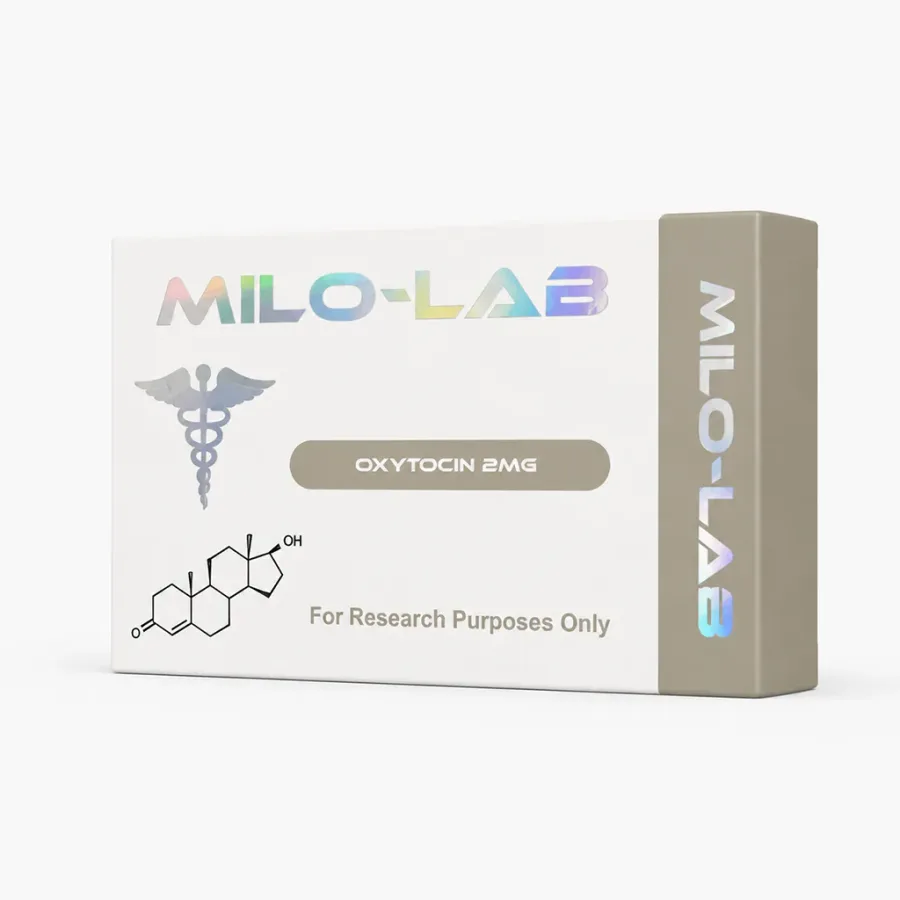
Oxytocin
Oxytocin is a 9-amino-acid hypothalamic neuropeptide and oxytocin-receptor agonist studied for social bonding, trust, stress reduction and prosocial behaviour.
Total Price
฿1100
For research & laboratory use only. Not for human consumption.
Half-Life
~1-6 minutes (plasma); central effects longer
Administration Route
Intranasal (central effects); subcutaneous or intravenous (peripheral effects)
Trust & Bonding Hormone
"Love hormone" mediates social attachment and trust
Stress & Anxiety
Activates parasympathetic nervous system and reduces cortisol
Social Cognition
Improves recognition of emotional facial expressions and empathy
Mechanism of Action
Scientific Research
Nature (2005)
Proc Natl Acad Sci USA (2011)
Mol Autism (2013)
Oxytocin Receptor Distribution and Function
The oxytocin receptor (OTR) is a Gq-coupled GPCR expressed in:
Limbic system:
- Amygdala (basolateral, central nuclei) - fear and threat processing
- Hippocampus - social memory formation
- Nucleus accumbens - social reward
Hypothalamus:
- PVN (autoreceptor function)
- Lateral hypothalamus - appetite modulation
Brainstem:
- Locus coeruleus - stress response modulation
- Dorsal raphe - serotonin interaction
OTR activation in the amygdala reduces threat-responsive neuronal firing, which manifests behaviourally as reduced social anxiety and enhanced prosocial motivation.
The 2005 Nature Study and Its Context
The Kosfeld et al. paper demonstrating that intranasal oxytocin increases trust in economic games made oxytocin famous as the “trust hormone.” However, the subsequent decade of research produced a more nuanced picture:
- Trust enhancement is strongest for in-group/similar social targets
- Context dependency: oxytocin can increase both trust and vigilance depending on social context
- Individual differences in OTR polymorphisms (rs53576) predict response
- Baseline peripheral oxytocin predicts social cognition in both typical and ASD populations
Autism Research Status
The most rigorous meta-analyses of intranasal oxytocin in ASD (as of 2023) show:
- Positive: Some improvement in social cognition tasks in laboratory settings
- Inconsistent: Mixed results across RCTs for real-world social function
- Active question: Whether dose, duration (acute vs chronic), or participant selection drives variability
- Consensus: More targeted studies with biomarker-defined subgroups are needed
Storage
Reconstitution: use bacteriostatic water; swirl gently until dissolved, do not shake. Protect from light. After reconstitution: keep refrigerated and use within 2-3 weeks.
For research purposes only. Not for human consumption.
Dosing at a Glance
Route
Intranasal (central effects); subcutaneous or intravenous (peripheral effects)
Frequency
As needed
Typical research dose
10–40 IU
Opens the calculator with this peptide preselected. Research reference only.
Product FAQs
Stacks Well With
Related Products
Selank
Selank is a synthetic tuftsin-analogue heptapeptide developed in Russia, studied as a non-sedating anxiolytic and nootropic that raises BDNF.
Semax
Semax is a synthetic ACTH(4-7) heptapeptide nootropic that upregulates BDNF and NGF for cognitive enhancement and neuroprotection.
DSIP
DSIP (Delta Sleep-Inducing Peptide) is an endogenous nonapeptide that promotes deep delta-wave (slow-wave) sleep and buffers stress-driven cortisol.